

Adrift in the Ice – Steam Tug Prince Alfred
by Patrick Folkes, reprinted with permission, 2025.
In 1879, the 60-foot steam tug Prince Alfred, formerly of Waubaushene, was brought to Wiarton to replace the O’Koura which had burned on Colpoys Bay the previous summer. Andrew Port, later of the ill-fated Jane Miller, owned and commanded the Prince Alfred which had been launched at Brockville in 1867. Placing her in a coastal service from Owen Sound to Lion’s Head, he offered a daily, one-way passage from Wiarton to Owen Sound for 75 cents.
The winter of 1879-80 was unusually mild and the Prince Alfred was able to ply regularly to Owen Sound through January and February. Nevertheless there was ice and on several occasions she was trapped in Colpoys Bay. But with the likelihood of an early spring Captain Port grew more venturesome and on March 6 set out from Owen Sound for Michael’s Bay, Manitoulin Island, with a load of freight and a handful of passengers, including Robert A. Lyon, MPP for Algoma (the provincial parliament had prorogued on March 5).
The Prince Alfred made fair weather until a gale came up, within a few miles of Michael’s Bay, and forced a retreat to the shelter of the Bruce Peninsula. An attempt to enter Tobermory harbour was blocked by ice and when Captain Port tried to push a way through he was quickly thwarted. And despite repeated attempts to break free, there the little steamer sat, fixed solidly in the ice, half a mile from the shore.
The next four days were spent trying to break the Prince Alfred from her frozen prison, but to no avail. In the meantime the frustrated Mr. Lyon took a small boat with the intention of crossing over to Manitoulin. He got as far as Cove Island, then, judging the rest of the voyage too hazardous, gave up. With no possibility of getting out on the Prince Alfred, Lyon started south by land and on the 13th, after a two-day trek, reached Owen Sound. On the 15th he arrived in Gravenhurst by train, then Parry Sound by stagecoach. Ahead lay a journey by dog-team, horse-drawn sleigh, and on foot to Collins Inlet, Killamey, Manitowaning, and finally home to Michael’s Bay on the 21st.
With the Prince Alfred confined for the foreseeable future, Captain Port made good use of rather limited prospects. He engaged 20 men and two teams of horses and began to cut blocks of ice out of the harbour. By the time the Prince Alfred was able to break free on April 4, 500 tons of ice had been lifted and stored for the spring fishery. Captain Port was, in the words of a newspaper account, to be credited for his “thrift and enterprise.”
The Prince Alfred reached Michael’s Bay without incident and the next day, the 5th, having taken on several passengers from Manitowaning, steamed away for Owen Sound. There was open water enough into Georgian Bay, but off Cabot Head a vast expanse of ice was encountered. Port drove ahead regardless and managed to penetrate it until, abreast of Lion’s Head, the rudder broke and the steamer came to a complete halt.
Once again the Prince Alfred was held fast in the ice. This time there was no safe harbour and the helpless steamer was soon at the whim of wind and current, drifting to and fro about Georgian Bay. The situation on board was exacerbated by a lack of fuel, only a half day’s supply being on hand. In order to have enough in reserve for a final dash for port when the ice broke up, the boiler fire was drawn down. For the next nine days the crew and passengers were in the most uncomfortable, even dangerous, circumstances. There was always the possibility that the hull would be crushed and the vessel sink. A strong southwest wind pushed the ice pack into the northern part of the Bay and then a northeasterly gale drove it back. On the 10th the ice came in on Cape Croker. By then passenger Joseph Maughn had had enough and went over the side and walked ashore.
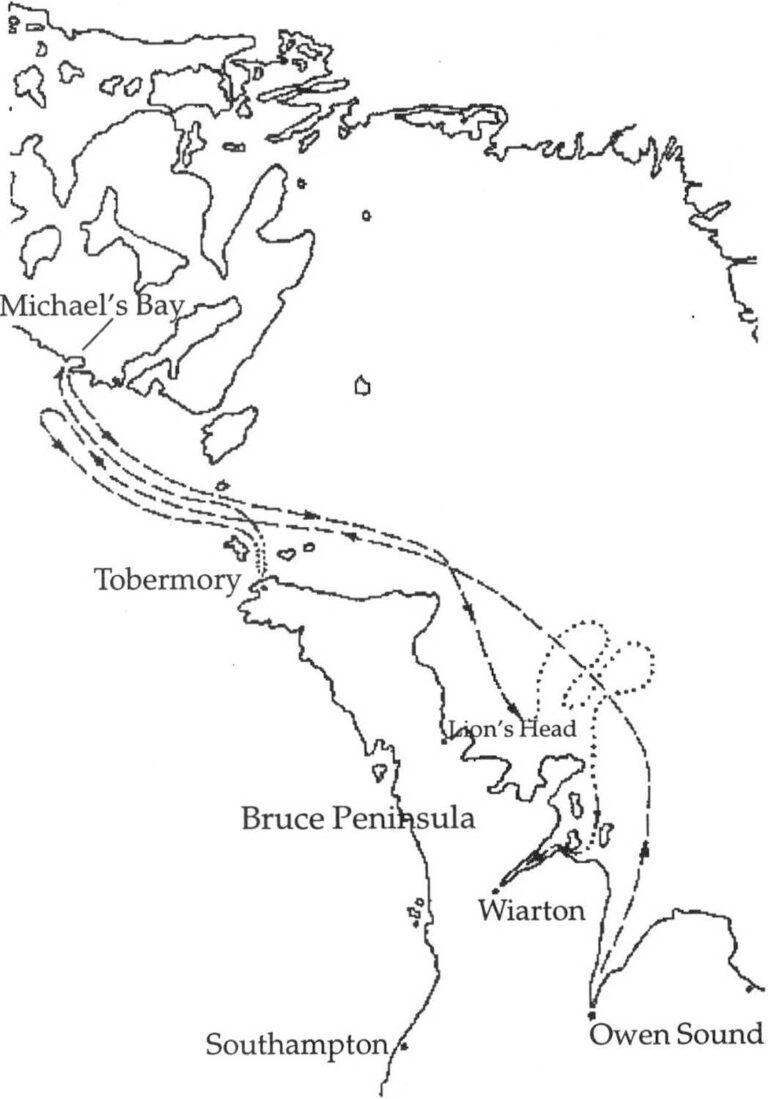
Route of Prince Alfred:
Prince Alfred left Owen Sound on Mar. 6. Its route while under power is shown as _ _ _ _.
Those portions of the trip for which it was adrift, its approximate route is indicated as ………
Map: Stan McClellan
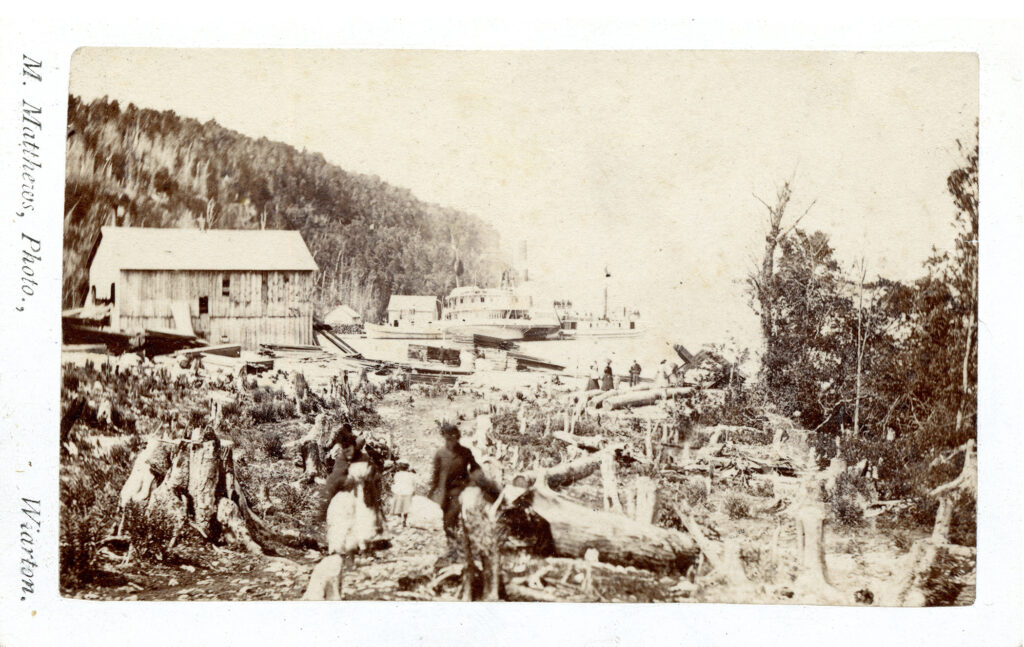
The floe was drifting south toward Colpoys Bay and eventually placed the Prince Alfred near Hay Island. Another night brought the steamer into the narrow water between White Cloud Island and the mainland. By the 12th the ice surface was consolidated enough for Captain Port to walk over to Big Bay (North Keppel) and arrange for a message to be sent to his family. A further two days passed and the Prince Alfred still ice-bound, came into Colpoys Bay. But now, with steam up and a jury-rigged rudder, Captain Port picked his way through the pack and brought his vessel into shore where firewood was taken on. Through the following night the Prince Alfred crept carefully among the remaining patches of ice and at 8 o’clock in the morning of April 15 pulled alongside the dock at Wiarton.
Captain Port was widely acclaimed for his handling of the Prince Alfred and the survival of all on board. The Wiarton Echo congratulated him for “his indomitable pluck in sticking to his craft and bringing her safely through so many perils.” For his part, Port hardly took time to catch his breath, for spring was certain and the ice finally disappearing. Within a week the Prince Alfred was repaired, painted and back on her usual route.
In June Captain Port made a deal with James Miller, of Little Current, for the steamer Jane Miller. Miller took the Prince Alfred. Ironically, Port and his new command would vanish in 1881, with all on board, in the same area of Colpoys Bay where a year before he had finally escaped from the ice. James Miller used the Prince Alfred to tow logs in the North Channel and then placed her in the Killrney fishery. But the tug must have been a failure for she was laid up as unfit for service in 1882 and thereafter disappears from the shipping records.
About the Author and Article
Patrick Folkes has spent more than six decades researching the marine history of the Great Lakes, with a special interest in the ships, shipwrecks and sailors of Bruce County. He has an MA in history from York University where his research was on the Seamen’s Benevolent Union, 1878-1885. He is the author of “Shipwrecks of the Saugeen, 1828-1938″, “The Saddest Calamity: The wreck of the Steamer ‘J.H. Jones’”, a history of the Cabot Head Lighthouse, and a study of cooks and ladies’ maids, women employed on the Lakes in the nineteenth century.
This article, based on contemporary reports in the Manitoulin Expositor 14 (Manitowaning) and Echo (Wiarton), first appeared in the Queen’s Bush Quill (Owen Sound), Sept. 18,1974. It was revised by the author for publication in “Historical Notes Yearbook Edition” 2003, pages 11 to 14, by the Bruce County Historical Society. It was uploaded to BCM&CC’s website in 2025 with the permission of Patrick Folkes and the Bruce County Historical Society.
Visit newspapers.brucemuseum.ca to read all Historical Notes Yearbook Edition volumes from 1967 to 2010.
Bruce County Archives and Ontario Marine History and Underwater Archaeology Research Centre
Since 2021, Bruce County Archives has been home to the Ontario Marine History and Underwater Archaeology Research Centre, a repository for shipwreck-related documents and other underwater site information and research resources from across Ontario. Visit the Marine section of the Research Information page for descriptions of some of the marine material housed at the Archives and Research Centre.