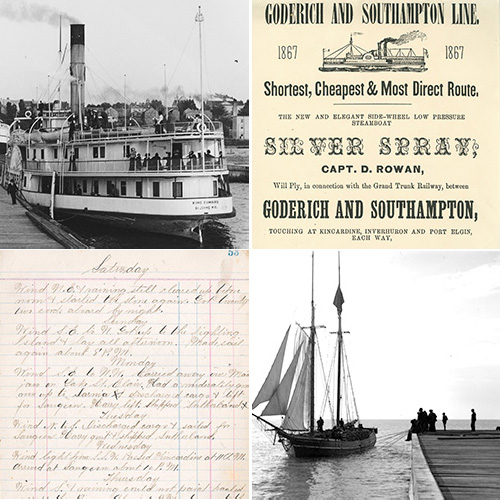


In the late 19th century, Georgian Bay was a busy corridor of commerce and travel, connecting shoreline communities through a network of steamers and schooners. Among these vessels was Jane Miller, a wooden propeller steamer whose story reflects both the promise and the perils of Great Lakes navigation.
A New Steamer on the Bay
Jane Miller was built in 1879 at Little Current by James Miller, who named the ship after his wife, and also served as the vessel’s captain. Designed to carry both passengers and cargo, Jane Miller travelled routes between Collingwood and Manitoulin Island, serving communities along the south and west shores of Georgian Bay, as well as Manitoulin Island ports.
During its first year of service, the steamer operated reliably, transporting freight and travellers with few serious incidents. One notable mishap occurred in September 1879, when Jane Miller collided with, and heavily damaged, the schooner Mountaineer near Owen Sound. Later that year, after enduring a four‑day storm on a voyage from Owen Sound to Manitowaning on Manitoulin Island, the vessel was dry‑docked and fitted with a new propeller—evidence of both the challenges of Great Lakes travel and the routine maintenance required to keep steamers in service.

New Ownership and a Busy Route
In June 1880, Jane Miller was sold to Andrew Port of Wiarton who served as the ship’s skipper. His sons, Richard and Frederick Port served as captain and purser. Under the Port family’s operation, the steamer provided general freight service along a route connecting Wiarton and Owen Sound with Providence Bay on Manitoulin Island. Advertised as an inexpensive and swift option for travellers, Jane Miller likely became a familiar sight along the south shore of Georgian Bay.

The Final Voyage
Jane Miller set out on its final journey on November 25, 1881 – the last scheduled trip of the season.
The voyage began by loading cargo at Owen Sound, then continuing to Meaford where they took on an additional 30 tons of freight and more passengers. After a brief stop in North Keppel, Captain Richard Port noted that the ship had been rolling heavily and and had taken on a decent amount of water. He aimed to continue to Spencer’s Wharf, on the south shore of Colpoy’s Bay, to get more wood to fuel the ship. The plan was to stop next at Lion’s Head to unload cargo, before continuing on to the final destination at Michael Bay, Manitoulin Island. Jane Miller would never complete this route.
That night, eyewitnesses reported seeing the lights of Jane Miller between White Cloud Island and the mainland. Reports noted that the vessel appeared to turn to toward Spencer’s Wharf, and suddenly, the lights went out. Jane Miller vanished into the darkness of the bay.
Wreckage, Loss, and Unanswered Questions
In the days that followed, debris from the missing steamer began to wash ashore. Items including a tub of butter, part of a mast, and small fragments of the vessel were found on White Cloud Island at the entrance to Colpoy’s Bay. Despite search efforts, the wreck itself could not be located. Searchers suggested that Jane Miller may have sunk in deep water, possibly settling into one of the limestone crevices that characterize Colpoy’s Bay’s lakebed.
While exact numbers were not confirmed, the ship sank with around 30 people aboard, including nine crew members. No bodies were recovered.
Analysis at the time, led to a conclusion that heavy deck cargo made the ship unstable and, combined with winds from the snowstorm, likely caused the vessel to capsize and sink while making its final turn into Spencer’s Wharf.
Rediscovery Beneath the Bay
For more than a century, Jane Miller remained lost. On July 27, 2017, the wreck was discovered Colpoy’s Bay by Jared Daniels, Jerry Eliason, and Ken Merryman. Remarkably, the vessel is largely intact, with its mast still standing upright and only the upper cabins collapsed.
Today, the wreck site is a registered marine archaeological site and is protected from being disturbed by the Ontario Heritage Act.
Preserving Bruce County’s Marine Heritage
The story of Jane Miller is just one chapter in Bruce County’s rich marine history. The Bruce County Archives, part of the Bruce County Museum & Cultural Centre, preserves books, reports, articles, and photographs related to shipwrecks, harbours, and vessels that once travelled Lake Huron and Georgian Bay. These resources help tell the stories of the people, communities, and industries shaped by the water.
The Archives continues to welcome donations of photographs and documents connected to Bruce County’s marine past. These contributions play a vital role in expanding our understanding of the region’s vibrant maritime heritage and ensuring these stories are preserved for future generations. Contact archives@brucecounty.on.ca or call the Research Room 226-909-2893 to discuss a possible donation.
For more information about the types of marine resources already donated, and available for research, have a look at our Navigating Bruce County’s Marine Resources article.
Sources
- Folkes, Patrick. “Shipwrecks of the Saugeen 1828 – 1938: a History of Marine Disasters of Bruce County,” 1970. Print. Bruce County Museum & Cultural Centre. AX2004.0259.
- Gowan, Rob. “136-year-old shipwreck found in Georgian Bay — and bodies may be on board,” Toronto Sun, 5 December 2017. https://torontosun.com/news/provincial/136-year-old-shipwreck-found-in-georgian-bay-and-bodies-may-be-on-board.
- Gowan, R. “No human remains found inside 1881 Georgian Bay shipwreck: OPP,” The London Free Press, 18 October 2018. https://lfpress.com/news/local-news/no-human-remains-found-inside-1881-georgian-bay-shipwreck-opp.
- “Jane Miller,” Ships of the Great Lakes. Wiarton Propeller Club. Accessed January 12, 2026. https://www.wiartonpropellerclub.ca/heritage-memories/great-lake-ships#h.fepu0bgiw3fp
- Kohl, Chris and Joan Forsberg. “Canada’s 150 Most Famous Great Lakes Shipwrecks,” 2017. Print. Bruce County Museum & Cultural Centre. A2023.013.001.
- “Loss of the “Jane Miller,” Plaques. Ontario Heritage Trust. Accessed January 12, 2026. https://www.heritagetrust.on.ca/plaques/loss-of-the-jane-miller.
- “No Doubt but the Jane Miller has Gone down,” The Bruce Reporter, 8 December 1881.