





In 1903 a group of campers gathered on Cranberry Island for their annual picnic party. While guests enjoyed music and games, the main objective of the gathering was to discuss land matters such as fishing, road maintenance and building the dock. During their meeting, members decided to form a group known as the Oliphant Camper’s Association. The following years would still host the annual picnic, but it was decided to turn their gatherings into a Regatta. The Oliphant Camper’s Association would continue the legacy for many years making it one of Canada’s longest running Regatta events that is still being held today.
Early Regatta Days
 The first Regatta was held at the Government Dock in 1906. The Regatta would typically be scheduled for a day during the first week in August. Earlier Regatta events would be held on a single day of the week excluding Sundays. As the popularity and the addition of races were added to the itinerary, the Regatta would be held over two days. In 1925, the association moved to have the Regatta on the second Tuesday and Wednesday in August. Of course, weather would be a factor to schedule the events and would sometimes need to be postponed. Now the Regatta is a full weekend event and is typically still held around the Civic Holiday weekend in August.
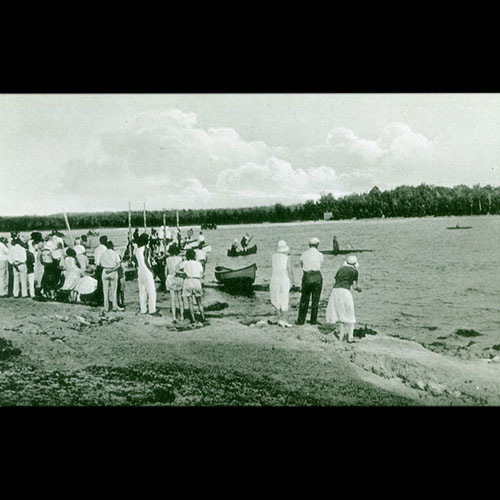
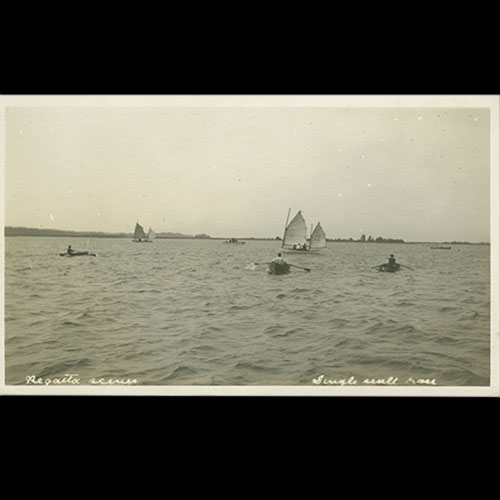
Over the years, the Regatta was held throughout various spots in Oliphant all dependent on water levels. The main dock and the “gut” were the central areas for spectators to gather and watch the events. Lonely Island, Smokehouse Island and Whiskey Island were all used for sailing races and long-distance swimming especially in the 1930’s and 1960’s when there were record low water levels. Residents built a dock off Smokehouse Island to keep the event going, and at one-point spectators and participants could drive to the islands.
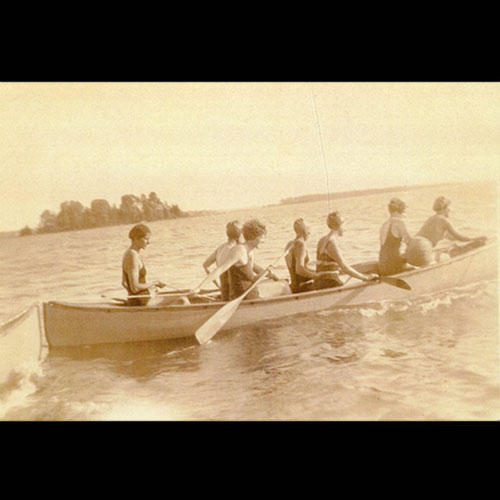
 The early days of the Regatta had rowing, canoeing, sailing, swimming, and running events with an addition of fun categories such as best decorated watercraft, and children’s costume parties. The war canoe races were a popular event and often saw rivals Shore vs Island teams compete. There were boys and girls war canoe races which would consist of seven or more in a large canoe. Chants of “Island” and “Shore Shore” could be heard across the water as the teams challenged one another. The races would always be entertaining no matter the age category as collisions and “man overboard” were frequent. The Island vs. Shore fun rivalry still holds true today.
The Main Events
The Regatta has stayed consistent over the years with the focus being on aquatic events such as sailing, canoeing, and swimming with the addition of running races. The participants were mainly young folk ranging in ages from 5 to 18 years and had both boy and girls’ categories. It wasn’t until the later years where mixed events were added. There have been additions to the event itinerary along with some removals as the popularity and number of participants grew. Throughout the 1920’s more rules were added to those who were frequent winners, and the addition of overall champion titles and trophies were awarded for those participating in three or more events. There was a point system in place for where they placed in each event.

The museum collection has three trophies for overall champion awarded to Betty Huether in 1930, 1936 and 1940. Betty would have needed to compete in at least three events in swimming, sailing and running categories and her place in each event would be tallied by points. She would have had the highest point rating to receive these trophies. She was Junior Champion in 1930, and Senior Champion in 1936 and 1940.
 By the late 1910’s into the 1920’s the addition of horsepower motorboats became a race and was mainly for boys and men to compete. There were other events that sparked fun in all ages such as the sack races, relay races and softball games. In the 1950’s they added a waterskiing competition to the itinerary allowing members to show off their acrobatic skills in the water. By the 2000’s there was the addition of bicycle races, a poker run and fishing derby.
Most events were divided into boy and girls’ categories and in the 1980’s it can be seen from the Regatta event pamphlets there was the inclusion of mixed events in canoe races and relay races. The Regatta started out focusing on a younger generation, but eventually opened more categories so all age groups could participate. When not specified, Junior meant 11 years and under, Intermediates were 12-15 years, and Seniors were 16-24 years. In the 1980’s the association added the categories of Veterans that were 24-39 years, and Masters was 39+. In 2005 the Legend category was added for those age 50+.
 Since the beginning, there has been prizes awarded to the First and Second place winners. Trophies, ribbons, and pennants were awarded in some categories while other prizes consisted of fishing poles, knives, paddles, baseball bat and mitt, and bathing caps to the young winners. At one point during the later years of the Regatta, candy was handed out to the young participants who sometimes favored the treat more than the ribbon.
The Regatta had a dance as part of the evening celebrations. Once started on the dock and beach area, eventually was moved to McKenzie’s pavilion in the 1950’s. The last dance held at the pavilion was in the 1975. The Regatta closed with a bonfire and fireworks display. The first noting of fireworks at the Regatta can be seen in the Chesley Enterprise newspaper in 1908. The tradition of fireworks and a bonfire is continued today. On Sunday, a service was held at the Camper’s Church along with the award ceremony.
The General Rules, Over Time…
 From the beginning, participants in the Regatta had to be members of (or an immediate family member of) the Oliphant Camper’s Association. There were general rules to the competitions making sure all events were on time. As always, the judge’s decision was final. The start of the point system for the general proficiency and overall champion can be seen in the early days to the most recent regatta rules. As the Regatta grew there were more rules added mainly focusing on the safety of the participants. There is mention of mandatory life jackets and a tender required for all long-distance swimmers with at least one adult.
The Regatta During the War Years
During the First World War the Regatta events were still happening, but their focus shifted to fundraise for the war efforts. The Regatta event dates can be found in newspapers from 1914-1918. In 1915, the Chesley Enterprise notes a garden party was held to raise funds for the Red Cross. The garden party raised $185 along with a $50 donation from the Camper’s Church. In 1916 and 1917, there is mention of a small attendance at the Regatta. In 1918 there was an article in the Canadian Echo talking about the efforts made by the O.C.A. to send money to their soldiers overseas. There was a concert to raise money along with an auction and sale of flags/buntings that all added to the pot. In the end, the O.C.A. was able to send $5 to each of their 15 soldiers overseas.
The Second World War saw the cancellation of the Regatta event in 1942. The reason behind cancelling was the absence of teenage boys and girls in the area.

Interesting Facts:
- The first lamps installed on the dock was in 1921
- Vera King was the O.C.A.’s first female president in 1943
- Hydro reached Oliphant in 1952 and a sound system was used for the event. Previously the commentators had to use megaphones
- C.A. decided to become incorporated in 1963, and was in the charter by 1965
- There are only a few years that the Regatta was cancelled – during the Second World War and during the Covid-19 Pandemic
- The O.C.A conducted a virtual Regatta event in 2020 and 2021 due to restrictions of the Covid-19 Pandemic that included a 2km and 5km road race
 The Oliphant Regatta continues to be an annual event that many look forward to. There can be over 300 people that attend today’s weekend Regatta. Many families who attend come from multiple generations of participants. The Regatta can be the summer highlight for many families and residents with thanks to the continued members and volunteers of the Oliphant Camper’s Association.
Sources:
Accession A2016.001
Accession A2008.061
The Canadian Echo. August 19, 1914 Vol. XXXVIII No.52
The Canadian Echo. August 16, 1916 Vol. XI No._
The Canadian Echo. August 8, 1917 Vol. XXXVIII No.4
The Canadian Echo. August 7, 1918 Vol. XXXIX No.5
The Chesley Enterprise. August 13, 1908 Vol. 32 No.50
The Chesley Enterprise. August 19, 1915 Vol. 40, No. 38
The Chesley Enterprise. August 9, 1923 Vol. 47, No.27
Amabel Township Historical Society. “Green Meadows & Golden Sands: the History of Amabel Township 1851-1982.” Amabel Township Historical Society, 1984.
Whiting, Ruth. “Put on Your Old Grey Bonnet”, Bruce County Historical Society, 1993. Print.
Oliphant Campers Association Facebook Page
Oliphant [Postcard]. Krug family fonds. A2014.008.0571. Bruce County Museum & Cultural Centre
Government dock at Oliphant and cottages on shore [Postcard]. Krug family fonds. A2014.008.0572. Bruce County Museum & Cultural Centre
Racing scenes, single swell race [Postcard]. Krug family fonds. A2014.008.1537. Bruce County Museum & Cultural Centre
Ladies War Canoe [Photograph]. 1930s. Oliphant Campers Association fonds. A2016.001.016. Bruce County Museum & Cultural Centre
Oliphant Regatta [Photograph]. Before 1948. Oliphant Campers Association fonds. A2016.001.024. Bruce County Museum & Cultural Centre
Oliphant Regatta Program 2006 [Digital Document]. Oliphant Campers Association fonds. A2016.001.042. Bruce County Museum & Cultural Centre.
95th Annual Oliphant Regatta 2001 official ribbon [Digital Document]. Oliphant Campers Association fonds. A2016.001.044. Bruce County Museum & Cultural Centre.