

Beginnings
Krug Brothers & Co., later known as Krug Bros. Co. Ltd., was a family-owned furniture manufacturer that operated for just over 100 years in Chesley, Bruce County, Ontario. Founded in 1886 by Christian Krug, the business began with a partnership agreement with his twin brother Conrad, their older brother John, and brother in law Henry Ankenmann. Before establishing the company, the partners gained experience in furniture factories in Listowel, Ontario, and Cleveland, Ohio.
The company was incorporated on November 26, 1909 as The Krug Bros. Co. Ltd. On April 2, 1931, the company received a Dominion Charter allowing it to sell furniture in all Canadian provinces. At that time, the company name changed to Krug Bros. Co’y Limited, though the traditional name also continued to appear in catalogues and marketing materials.

The People of Excellence
Several members of the next generation entered the family business. Some of them include John Krug’s sons, William Peter Krug, who acted as the company book keeper and managed areas of operations and production , and Stanley Krug who managed the shipping department. Christian Krug’s son Wilfred set up the company’s cost system. Another of Christian’s sons, Howard Henry Krug (1904-1997), joined the family company in 1925, working in every department of the business. When John Krug died in 1937, Howard took over forest management – purchasing the timber and logs and maintaining the company woodlots
In 1941, Christian passed away, and Howard became President / CEO. Howard’s youngest brother Bruce Arthur Krug (1919-2013) joined him around 1946.
Excellent Locations
100 2nd Street SW, Chesley, Bruce County, Ontario
The first Krug factory building was erected in 1886 on the north side of the Saugeen River in Chesley around the address now known as 100 2nd Street SW Chesley (across the bridge and dam from where Rolston’s sawmill stood for years). It was a three-storey building, measuring 52 x 36 feet. A heating plant and dry kiln was built north and west of the main factory building. Less than a year after opening, in January 1887, fire partially destroyed the kiln. The business carried on. By March 1887, the company was manufacturing chairs. In August, they raised the frame for a second building on the same side of the river, slightly upstream. The two buildings were eventually brought together by a bridge completed in January 1889, joining the top floors of the two buildings. This was the first of many expansions as Krug Bros. grew rapidly from 1886 to 1900. Krug Bros. purchased the Rolston property on the south half of the dam across from their factory in 1891.
Corner of 1st Ave. S. & 7th St., Chesley, Bruce County, Ontario
In 1911, the manufacturing facilities were moved from the river plant to Main Street on the corner of streets now known as 1st Ave. S. and 7th St. This location was conveniently located next to railway tracks, to facilitate sales across Canada and delivery of supplies. Before 1881, deliveries to near-by locations were made by horse-drawn wagon. After 1881, with the arrival of the Grand Trunk Railway, orders could be shipped anywhere in Canada.


Original Krug factory, around 1910, A2014.003.1-12-1; Krug Bros. Co’y Limited sales postcard, A2014.008.0116
Innovation Supports Excellence
From early on in their history, Krug Bros. supported innovation. For example, J.E. Merriam of Chesley patented a baker’s cabinet in 1889 that featured special drawers for housing flour, etc., as well as a drop-down baker’s board, which was manufactured by Krug Bros. In 1892, Krug Bros. sold the rights to this patent to Union Furniture & Merchandise Company Ltd. for $150 plus twenty-two cents royalty per cabinet sold, or a flat payout of $1,000.

In 1908, for $100, Krug Bros. purchased from Chesley’s H.C. Lorenz the rights to his design of knock-down dovetail joints for rocking chairs and davenports. At the time of sale, the patent was pending, and it doesn’t appear the patent was approved. In 1911, for one dollar they purchased the rights to manufacture “Becker’s Automatic” a folding ironing board that featured a space for an iron and a small board for clothing sleeves affixed to the top. The fee for the right to manufacture was small; however, the contract shows they had to give fifteen cents royalty on each unit sold and they were to manufacture no less than four thousand boards per year.
Not just in the business of purchasing patents for product use, Krug Bros. also had innovative owners and staff. In January 1890 Christian Hauser patented an extension table that featured leaves that slid out from under the main table surface. This table became known as the Hauser refectory table, one of which is preserved in Bruce County Museum & Cultural Centre’s Collection.

In 1902 Christian received a patent for a drawer slide that would “with but little friction, run smoothly in operation, and to simplify construction, lessen mechanical labour, and thereby cheapen manufacture.” Krug Bros. dresser, model number 498 5/8, was one of the first models to be offered with the new design.
As innovators, the Krug buildings were the first to use electricity in Chesley. They installed a dynamo (a generator that converts mechanical energy into electrical energy using electromagnetic induction) in 1894 to create electricity used to light the factory and their homes on River Street. This was the start of the factory augmenting water / steam power with electrical power for their operations. Supporting a community helping one another, the Krug family arranged for another dynamo to be installed on the property of mill owner William Elliott (known as the founder of Chesley) to create additional electricity for the mill and surrounding homes.

Product Excellence
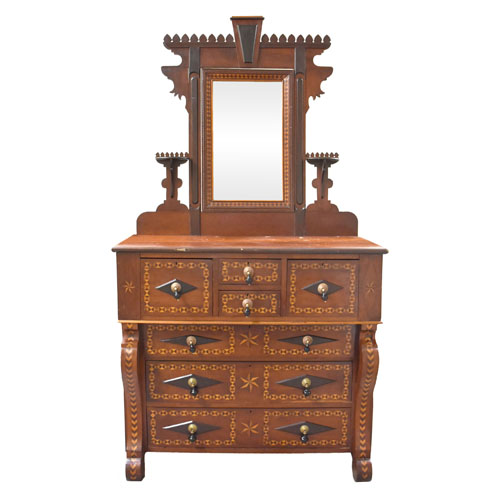
Krug Bros. Co. Ltd. manufactured fine quality colonial and traditional furniture, with sales across Canada.
Bedroom and dining room furniture formed the primary product lines throughout the company’s existence. Springs and mattresses were also part of the product line until about 1914. Church furniture, including pulpits, pedestals, chairs and communion tables, was manufactured until about the 1960s. Lodge furniture was also a significant part of Krug operations when fraternal lodges were growing.
During the 1930s, tastes in furniture began to shift and more modern designs became popular. Plainer styles with fewer carvings were preferred. In the late 1930s, an “Early American” bedroom suite in maple was introduced. First becoming popular in the United States, stores in the American border areas began asking for it. More pieces were added, and by the 1980s, this style became Krug’s main line of furniture. In 1986, approximately 75% of the factory’s production was the Early American style.

Excellent Forestry Practices and Raw Materials
Around 1900, the company acquired approximately 600 acres of land with good standing hardwood in Grey County. Over the years, the company and/or Bruce and Howard Krug continued to acquire tracts of timber in various Grey County townships and in the Bruce County townships of Amabel, Arran and Brant. Known for their responsible forestry practices, the company became recognized leaders in local reforestation, selectively harvesting woodlots while retaining about 75% of mature timber.

In 1997, Howard Krug donated 600 acres of the Kinghurst Forest to Ontario Nature, continuing the family’s longstanding commitment to conservation. Bruce and Howard also acquired other forest properties for sustainable use, many of which were later gifted for public benefit.
Krug Bros. operated a sawmill in Chesley until 1975, as well as a mill in Sullivan Township from about 1900 to 1918, converting timber from their woodlots into lumber.
The company also ran a successful maple syrup operation in the Kinghurst area from 1918 to 1952 and again from 1958 to 1963. It grew to a 2800-bucket operation. John Krug oversaw production until around 1929, with five employees, after which Howard assumed responsibility. The venture eventually ended due to difficulties finding seasonal labour.
That part of the business is reflected in BCM&CC’s Collection through:

Excellent Companies Support Communities
Krug Bros. Co. was involved in many community activities. The Chesley Citizens Band, a popular feature in Chesley, originated from the Chesley Mechanics Band organized by John Krug in 1887. Krug Bros. offered employment to bandmasters and musicians to entice them to Chesley, maintaining a high quality of performance. The band became a favourite entertainment at socials and garden parties. During the First World War, they became a regimental band for the 160th Battalion.
Krug Bros. also supported family, setting up Wellington Krug (Conrad Krug’s son) and Christian Ankenmann (Henry Ankenmann’s son) in business with the Chesley Chair Co. The close relationship is clear, as some of the Krug Bros. Co.’s furniture catalogues, 1924 to 1943, include listings of Chesley Chair Furniture.

Surviving and Thriving: Wars and the Great Depression
The years following WWI started off well, building up a good inventory of furniture in the factory warehouse by 1929. At the start of the Great Depression, the factory continued to work full-time, putting furniture into storage as the public’s capacity to buy new furniture waned. With the warehouse overflowing, they found extra storage space where they could. Except for one occasion, when about ten employees were discharged, there were no other layoffs in the factory during the Great Depression. However, work hours were limited, with a four-day work week: Monday to Thursday. In order to keep the business, wages dropped to very low rates and prices of furniture dropped significantly. Gradually, around 1935, business improved, normal factory hours were re-established, and excessive inventory was reduced to normal. With the start of the Second World War in 1939, and the consequent shortage of labour, the warehouse was almost empty by 1943. In 1942, Krug Bros. Co. Ltd. reported 107 employees; of those, 103 were male and 4 were female.
The End of an Era
In the 1980s when furniture factories began experiencing difficulties, Howard Krug sold personal securities to help finance the operations of Krug Bros. Co. Ltd. when banks refused further assistance. Unfortunately, this only delayed the company’s decline, as the economy was in a recession and interest rates were high.

From 1985 – 1987, Krug Bros. Co. worked with Bruce County in creating a proposal to turn the factory into a Centre for Industrial Furniture, a type of “living museum.” A feasibility study was conducted; ultimately, the proposal did not come to fruition.
With competition from Asian furniture makers growing, and Howard’s health declining, the company was eventually sold in 1987 to 665205 Ontario Limited, operated by Ray Smith and Associates of Toronto. Although they had seen it coming, the closing of the Krug factory was a very sad moment for Howard and Bruce Krug who had made it their lives’ work and that of their father and uncles. At its peak in the 1950s, the company employed 150 people. When it closed in 1987, the roster was 60.
After Krug Bros. Co. Ltd: the Building, Plaques and Park
In the 1990s, Chesley Market operated out of the building for a period of time.
In 1986, the Town of Chesley erected a stone monument in front of the factory commemorating the 100th anniversary of the company’s founding. In 2001 the cairn was moved to the site of the original factory, along the river, on land to be donated by the Krugs to the Town of Chesley.
The unoccupied building suffered deterioration and vandalism. By 2014, the building had been demolished.
On September 2, 2017, Krug Memorial Park was officially opened on the location of their first factory, 100 2nd Street SW, Chesley, recognizing the contributions of the company and Krug family to the community. The park was created under the guidance of a committee of community members, with Municipality of Arran-Elderslie Council approval, with funding provided by the Estate of Bruce Krug (1919-2013).
In 2018, interpretive plaques were also installed at the location from which the factory operated from 1911-1987, on the corner of 1st Avenue S and 7th Street, with funding from a Krug relative.
Gallery Photo Credits:
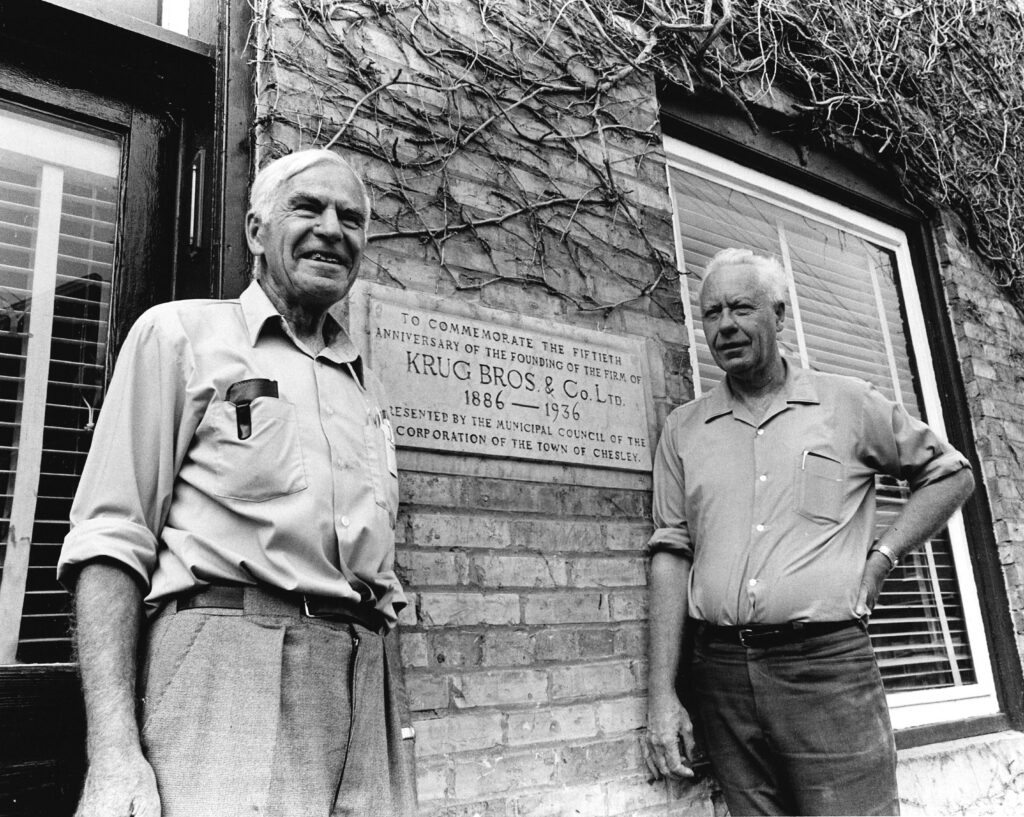
- Howard and Bruce Krug with 50th Anniversary commemoration plaque, AA2014.003.1-12-1c
- Krug Bros. & Co. letterhead, letter to Mrs. J.H. Elliot, June 9, 1905, A2014.003.1-2-2a
- Krug Bros. Upholstery Department, with foreman Harry Moss and other employees. 1928, A2014.003.1-12-1
- Krug Bros. & Co. furniture catalogue #18, page 3, 1904, A2014.003.0430
- Krug Bros Co’y Limited sales postcard, front, 1910s, A2014.008.0116
- Krug Bros. Co. washstand, around 1912, 988.010.038
Sources:
- Bell, Del. “Pride binds Krug workers.” The Sun Times, January 11, 1978. Bruce County Museum & Cultural Centre, A2014.003.1-12-3a.
- Borgal, Christopher. Krug Centre Feasibility Study, draft report, January 11, 1987. Bruce County Museum & Cultural Centre, A2014.003.1-1-1
- Bruce County Museum. “100 Years in the Furniture Business.” Tidbits and Treasures, Bruce County Museum Newsletter, summer vol. VIII, No. 21, 1986
- Carson, Pat. “Plaque recognizes Krug family’s contributions.” The Post. September 26, 2018. https://www.thepost.on.ca/news/local-news/plaque-recognizes-krug-familys-contributions
- Golem, Mary. “An era ends in Chesley with Krug death.” Owen Sound Sun Times, May 23, 2013. https://www.owensoundsuntimes.com/2013/05/23/an-era-ends-in-chesley-with-krug-death
- Hauser, Christian. “Application for patent” 1890, Bruce County Museum & Cultural Centre, A2014.003.1-4-3a
- Krug, Christan. Articles of Partnership, 1886, Bruce County Museum & Cultural Centre, A2014.003.1-1-1
- Krug, Christian. “Application for patent” 1902, Bruce County Museum & Cultural Centre, A2014.003.1-4-3-a
- Krug Bros Co. “Government records 1943” folder. Bruce County Museum & Cultural Centre, A2014.003.1-3-9c
- “Krug, Bruce Arthur” obituary. Bruce County Genealogical Society Surname Collection, Bruce County Museum & Cultural Centre.
- Krug Family Fonds, Series 1: Krug Bros. Co. Ltd. Series. Bruce County Museum & Cultural Centre, A2014.003
- Krug Family Reference folder, Bruce County Museum & Cultural Centre.
- Krug, Howard. “A Century of Excellence: Krug Bros. & Co. Furniture Manufacturers.” Ed. Ruth Cathcart. Toronto: Natural Heritage/Natural History Inc., 2001. Bruce County Museum & Cultural Centre, AX2004.0209
- Lorenz, Herman. Assignment of patent, Herman Lorenz dovetail construction of rocking chairs, 1908. Bruce County Museum & Cultural Centre, A2014.003.1-4-3-a
- McClure, Donald. “William Elliot, Founder of Chesley.” The Bruce County Historical Society Yearbook, 2005, pp.22
- Merriam, J.E. “Sale of Patent : J.E. Merriam’s Baking Cabinet #32377” 1892. Bruce County Museum & Cultural Centre, A2014.003.1-4-3a
- The Chesley Centennial Committee, “Chesley…Past & Present”, Krug Bros. Furniture Co. Ltd. Founded 1886, A2014.003.0065