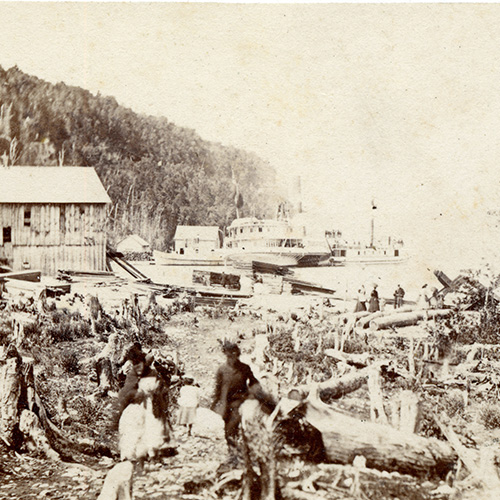


The Kaloolah
by Patrick Folkes, reprinted with permission, 2025.
The sidewheeler Kaloolah was one of the most famous steamers of the Lake Huron and Georgian Bay. Built in Buffalo, N.Y. in 1852 by Francis N. Jones for Aaron D. Patchin, the Kaloolah, of 620 tons, measured 138 feet in length. Its engine was very old, having been built for the sidewheeler, Uncle Sam, launched at Grosse Isle, Michigan, in 1833. When that vessel was converted to sail in 1844, it went into the Lexington, wrecked on Lake Michigan in 1850. The machinery was subsequently salvaged, and the engine put into the brand new Kaloolah.
The Kaloolah was sold to, or leased by Charles Thompson of Collingwood and renamed Collingwood. For several seasons, it busied itself hauling passengers and freight on Georgian Bay and into Lake Superior. In 1857 Thompson reverted to the original name, and in 1858 the Kaloolah was rebuilt at Detroit, probably as a result of severe damage sustained by running ashore on Superior’s Michipicoten Island the previous summer.

By the spring of 1860, the Kaloolah was in the hands of T.E. Van Every and George Rumball of Goderich who placed the well-known Kincardine Mariner, Duncan Rowan, in command.
Four times a week it steamed north to Southampton, touching at Kincardine, Port Head, Inverhuron, Baie du Dore, and Port Elgin. Twice a week it sailed south to Sarnia and Port Huron. As occasion required, the big sidewheeler was also used for special excursions, including a 4th of July trip to Detroit and a run up the lake, with decks crammed with London “pleasure-seekers”, many of whom “had the pleasure of getting their stomachs emptied” while the Volunteer Artillery Band played into a fresh wind.
During the autumn and winter of 1860, Kaloolah was taken in hand at Goderich and extensively reworked. In the spring it was advertised as having been “thoroughly overhauled, repaired and painted; its engines and boilers have also been overhauled and refitted and she is, altogether, better than ever. She has superior cabin and state-room accommodation (having been fitted with fifteen additional state-rooms), and large carrying capacity.”
On August 18, 1862, the St. Catharines’ brig Sir Charles Napier went aground at the mouth of the Saugeen River, Southampton. The Napier’s master quickly went over to the Kaloolah, then lying inside the bar, and requested assistance of the captain.
The brig lay in an awkward position and, in trying to pull it off, the Kaloolah fouled a paddlewheel. This required it to withdraw to the Bogus Dock, south of the river near the present pumping station, to have it cleared.
While this was being done, a gale sprang up and forced the Kaloolah to make for the shelter of the Saugeen River. It was too close to the beach and fetched up on the rocks abreast of Southampton’s main street. Within a few days the salvage tug, Magnet, came up from Detroit, but on the 22nd, before anything could be done to save it, the Kaloolah was ravaged by heavy seas and went to pieces.
Although it was still a relatively new vessel, the Kaloolah was described on the occasion of the wreck as a “floating coffin” (no one died during the accident). Her owners had her insured for $10,000 among three companies, but had great difficulty in collecting on their loss.
Van Every brought a lawsuit against the Phoenix Insurance Company of Brooklyn, N.Y., which went through three trials before it was resolved in 1871. His claim foundered when a U.S. Circuit Court ruled that the alleged custom of one vessel aiding another in distress was not universal enough to fall within the policy assigned the Kaloolah for her usual employment.
About the Author and Article
This article was first published in “Historical Notes Yearbook Edition” 2002, pages 76-77, by the Bruce County Historical Society. It was uploaded to BCM&CC’s website in 2025 with the permission of Patrick Folkes and the Bruce County Historical Society.
Patrick Folkes has spent more than six decades researching the marine history of the Great Lakes, with a special interest in the ships, shipwrecks and sailors of Bruce County. He has an MA in history from York University where his research was on the Seamen’s Benevolent Union, 1878-1885. He is the author of “Shipwrecks of the Saugeen, 1828-1938“, “The Saddest Calamity: The wreck of the Steamer ‘J.H. Jones’”, a history of the Cabot Head Lighthouse, and a study of cooks and ladies’ maids, women employed on the Lakes in the nineteenth century.
Visit newspapers.brucemuseum.ca to read all Bruce County Historical Society’s Historical Notes Yearbook Edition volumes from 1967 to 2010.
Bruce County Archives and Ontario Marine History and Underwater Archaeology Research Centre
Since 2021, Bruce County Archives has been home to the Ontario Marine History and Underwater Archaeology Research Centre, a repository for shipwreck-related documents and other underwater site information and research resources from across Ontario. Visit the Marine section of the Research Information page for descriptions of some of the marine material housed at the Archives and Research Centre.